More Than a Day: Rethinking the Sabbath
We Like Rules
Let's be honest. We like rules.
Rules are clean. They tell us where the lines are. And if we're really honest, they give us something else we crave: a scorecard. I kept the rule. You didn't. I'm in. You're out.
For generations, that's what the Sabbath became for a lot of God's people. A day on the calendar with a long list of what you could and couldn't do. Keep the list and you could feel pretty good about yourself. Better yet, you could point at the guy down the street who didn't.
But what if the Sabbath was never meant to be a scorecard? What if it was meant to be a gift?
Love Is the Point
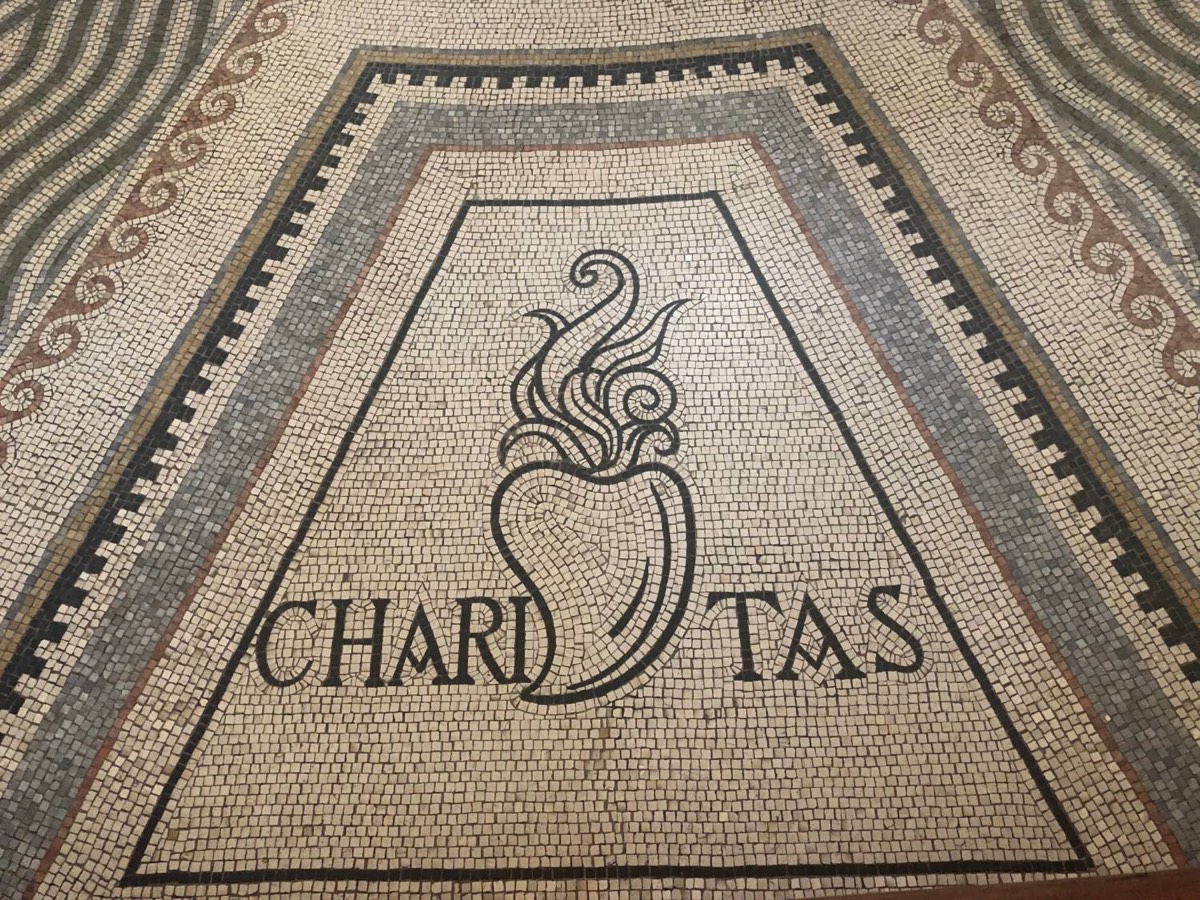
I took the photo below while standing in the Church of the Beatitudes, on the hill above the Sea of Galilee where Jesus preached the Sermon on the Mount. Set into the floor around the altar are mosaics of the seven virtues. This one stopped me. A heart on fire, and one word: CHARITAS.
Charitas is Latin for love. Not a warm feeling, and not a donation. It's the self-giving love of God poured out for others. When the Bible was translated into Latin, it's the word used for the love Paul describes in 1 Corinthians 13, the love that's greater than faith and hope.
Rules keep score. Love doesn't. And love was always the point.
When someone asked Jesus for the greatest commandment, he didn't hand them a rule. He said love God with everything you are, and love your neighbor as yourself. Then he added, "All the Law and the Prophets hang on these two commandments" (Matthew 22:40, NIV). Paul put it even more simply: "love is the fulfillment of the law" (Romans 13:10, NIV).
That's the lens for everything Jesus did with the law. Including the Sabbath.
Jesus Raises the Bar
On that same hillside, when Jesus sits down and preaches the Sermon on the Mount, he does something that must have stunned the crowd. He takes the commands they thought they had mastered and pushes them all the way down into the heart.
"You have heard that it was said to the people long ago, 'You shall not murder.' … But I tell you that anyone who is angry with a brother or sister will be subject to judgment" (Matthew 5:21–22, NIV).
You thought you were safe because you never killed anyone? Jesus says the hatred you carry is already murder in seed form. John would later put it plainly: "Anyone who hates a brother or sister is a murderer" (1 John 3:15, NIV).
Then he goes after adultery. "Anyone who looks at a woman lustfully has already committed adultery with her in his heart" (Matthew 5:28, NIV).
Do you see what he's doing? Jesus isn't lowering the standard. He's raising it. He's moving the law from the outside of my life to the inside. It's no longer enough to manage my behavior. God is after my heart.
And here's what I've come to believe: Jesus does the very same thing with the Sabbath.
Made for Us
The Sabbath wasn't Israel's invention. It goes all the way back to creation. God works for six days, and on the seventh he rests, blesses the day, and makes it holy (Genesis 2:2–3). Old Testament scholar Brevard Childs points out something I love: the Sabbath was given before humanity had done a single day of work. Adam's first full day wasn't a workday. It was a rest day. We didn't earn the Sabbath. It was a gift.
Over time, though, the gift got buried under the rules. By the time Jesus arrived, the religious leaders had built a fence of traditions around the day so tall that people couldn't see the gift anymore. Picking a handful of grain was work. Healing was work. The day meant to set people free had become one more burden to carry.
So Jesus kept the Sabbath, but he refused to keep their scorecard. When his disciples were criticized for picking grain, he said, "The Sabbath was made for man, not man for the Sabbath" (Mark 2:27, NIV). Then he went further: "The Son of Man is Lord even of the Sabbath" (Mark 2:28, NIV).
And he healed on the Sabbath. Again and again. When a man with a shriveled hand stood in the synagogue and the Pharisees watched to see if Jesus would break their rules, Mark tells us Jesus "looked around at them in anger and, deeply distressed at their stubborn hearts," healed the man anyway (Mark 3:5, NIV). They cared more about the rule than the man. Jesus cared about the man, because that's what the rule was for.
Remember that heart on fire? Charitas is the key to the Sabbath. The Pharisees saw a rule. Jesus saw a man with a withered hand. Love was always the point. The Sabbath was God's love built into the rhythm of the week: rest for the worker, the servant, the stranger, even the animals. When Jesus healed on that day, he wasn't breaking the Sabbath. He was showing us what it was for.
So when I say the Sabbath is now a mindset, I don't mean a quieter, more private set of rules. I mean a heart that rests in the Father's love, and that is set free to love others from that place of rest. A rested heart becomes a burning heart.
More Than a Day
Just as Jesus moved murder and adultery from the hand to the heart, he moved the Sabbath from the calendar to the soul.
The Sabbath is no longer simply a day. It's a mindset. An attitude. A soul-deep belief that I was not created simply to work. I was created to sit in the refuge and rest of the Father.
Listen to how Jesus invites us: "Come to me, all you who are weary and burdened, and I will give you rest" (Matthew 11:28, NIV). Rest isn't a place on the calendar anymore. Rest is a person.
The writer of Hebrews picks up the same thread: "There remains, then, a Sabbath-rest for the people of God; for anyone who enters God's rest also rests from their works, just as God did from his" (Hebrews 4:9–10, NIV). Notice that. A Sabbath-rest remains. It hasn't been cancelled. It's been fulfilled and opened wide in Jesus.
Now hear me carefully. This doesn't mean the weekly day of rest doesn't matter. I'd argue it matters more, not less. The Sabbath is not less than a day. It is more than a day. The day is where I practice what I believe the other six. If I can't stop for one day, I probably don't believe God is holding the other six together.
I Work, But It's Not Who I Am
Here's where this gets personal for me.
I work. I love to work. I build things, lead things, start things. But my work is not my identity. I produce, but I am not to make production my god.
That's the quiet temptation of our culture. We measure our worth by our output. We answer "How are you?" with "Busy." We wear exhaustion like a badge. And without ever saying it out loud, we start to believe that if we stop, everything falls apart. That if we stop, we're nothing.
That's not just a scheduling problem. It's a worship problem. When my work becomes the thing that tells me who I am, it has taken a seat that belongs to God alone.
Sabbath confronts that lie at the root. It says, "You are not what you produce. You are a son. You are a daughter. You are loved before you lift a finger." Remember, the first thing humanity ever did was rest. Identity came before productivity. Belonging came before doing.
So Sabbath as a belief means I can work hard on Tuesday without my soul being on the line. I can fail on Thursday without being a failure. I can set something down on Friday and trust the Father to hold what I can't.
Come and Rest
We can keep the Sabbath as a rule and still miss it completely. We can check the box on Sunday and spend the rest of the week running on fear, proving ourselves, and pointing at everyone who isn't keeping score as well as we are.
Or we can receive it the way Jesus offered it. Not as a scorecard, but as a refuge. Not as a day we survive, but as a belief we live inside every day of the week.
A few questions to sit with this week:
- Where am I using rules to feel good about myself or to judge someone else?
- If my work disappeared tomorrow, who would I believe I am?
- What would it look like to rest in the Father on a Wednesday afternoon, not just on a Sunday?
- What is one thing I need to set down and trust God to hold?
The invitation still stands. Come to him. Rest in his love. And then go love like he does.
Further Reading
- Brevard S. Childs, Biblical Theology of the Old and New Testaments (Fortress Press, 2011), 400–401.
- A. T. Lincoln, "From Sabbath to Lord's Day: A Biblical and Theological Perspective," in From Sabbath to Lord's Day, ed. D. A. Carson (Wipf & Stock, 1999), 345–346.
- Paul Heintzman, Leisure and Spirituality: Biblical, Historical, and Contemporary Perspectives (Baker Academic, 2015), 101–102.
Scripture quotations are from the New International Version (NIV).